


USB Token Update 2026: Is Your DSC Token Going to Discontinue? (FIPS 140-3 Guide)
📌 Introduction
If you are using a USB Token Update 2026 for your Digital Signature Certificate (DSC), this update is extremely important for you.
The Government of India, through the Controller of Certifying Authorities (CCA), has introduced a major change in DSC USB Tokens. The older FIPS 140-2 USB Tokens are being phased out and replaced with new FIPS 140-3 USB Tokens.

This means that your current USB Token may not be valid for new DSC issuance or renewal after a certain date.
In this detailed guide, we will explain everything about the USB Token update 2026, including deadlines, rules, impact, and how to upgrade your DSC USB Token safely
The Controller of Certifying Authorities (CCA) has officially issued an advisory mandating the migration from FIPS 140-2 to FIPS 140-3 validated cryptographic modules. This change impacts the entire PKI ecosystem, including Digital Signature Certificate (DSC) users, Certifying Authorities (CAs), OEMs, distributors, vendors, and government organizations.
If you use DSC for GST filing, MCA filings, Income Tax, e-Tendering, or compliance work, this update is critical for you.
This guide explains everything in detail:
- What FIPS 140-2 and FIPS 140-3 are
- Why migration is mandatory
- Key deadlines and compliance requirements
- Impact on DSC users and organizations
- OEM and CA responsibilities
- Exceptions and risk waivers
- What action you should take now
🔐 What is FIPS and Why It Matters?
FIPS (Federal Information Processing Standards) defines the security requirements for cryptographic modules such as:
- USB DSC Tokens
- Hardware Security Modules (HSMs)
- Secure Elements
- Software cryptographic modules
These standards ensure:
- Data confidentiality
- Integrity
- Authentication
- Protection against cyber threats
⚖️ Why FIPS 140-3 Replaces FIPS 140-2
FIPS 140-2 is now being phased out and replaced by FIPS 140-3, which aligns with international standards:
- ISO/IEC 19790:2012
- ISO/IEC 24759:2017
🔍 Key Reasons for Migration
FIPS 140-3 introduces stronger and modern security controls:
- Non-invasive attack mitigation
- Improved entropy & random number generation
- Strict software module validation
- Enhanced lifecycle assurance
- Reduced audit and compliance risk
- Stronger cryptographic resilience
- Non-proprietary global standards
- Compatibility with modern platforms (cloud, containers, virtualization)
📅 Critical Timeline & Deadlines
Understanding the timeline is essential for compliance:
🗓️ 1 January 2026
- CCA stopped accepting new audit applications for FIPS 140-2 modules
🗓️ 21 September 2026 (Major Cutoff)
- No new DSC issuance in FIPS 140-2 tokens
- FIPS 140-2 modules move toward Historical status
🗓️ 21 September 2029 (Final Deadline)
- Complete phase-out of FIPS 140-2
- Full migration to FIPS 140-3 mandatory
🔄 What Happens to Existing FIPS 140-2 Tokens?
According to global validation practices:
- FIPS 140-2 modules remain usable only for existing systems
- After 21 September 2026:
- They will be placed on the Historical List
- Cannot be used for new deployments
✔️ For DSC Users:
- Existing DSC → valid till expiry
- Renewal → NOT allowed on old token
- New DSC → Only on FIPS 140-3 token
⚠️ Important Exception (Reissue Case)
- If an active DSC needs reissue to the same user
- It may be issued once on a FIPS 140-2 token
- Only for the remaining validity
- No cost to the user
🏢 Scope of the Advisory
This migration applies to the entire PKI ecosystem under CCA, including:
- Software, firmware, hardware cryptographic modules
- Hybrid cryptographic systems
- Third-party FIPS-compliant products
- Internal applications relying on cryptography
- Infrastructure and enterprise systems
Additionally, stakeholders must prepare a CBOM (Cryptographic Bill of Materials) to ensure a trusted supply chain.
👥 Stakeholders Covered
The advisory applies to:
- Certifying Authorities (CAs)
- OEMs (Original Equipment Manufacturers)
- Distributors
- Vendors
- Organizations and enterprises
- Government bodies
- Individual DSC users
🏭 Responsibilities of OEMs & Distributors
OEMs and distributors must:
- Provide FIPS 140-3 compliant cryptographic modules
- Clearly publish buyback or exchange policies
- Replace old FIPS 140-2 tokens
- Ensure transparency in upgrade paths
🏢 Responsibilities of Certifying Authorities (CAs)
CAs must:
- Stop issuing DSC in FIPS 140-2 tokens after 21 Sept 2026
- Integrate FIPS 140-3 modules into systems
- Complete compliance audits by July 2026
- Publish:
- Updated price lists
- Exchange / buyback policies
- Inform CCA about policies by March 2026
- Publicize advisory widely
🏛️ Government Organization Exception
Government entities may:
- Continue using FIPS 140-2 only until 21 Sept 2029
- Must obtain:
- Ministry approval
- Risk assessment
- Compliance waiver
📄 Mandatory Requirement:
A formal Risk Waiver Letter must be submitted confirming:
- Understanding of risks
- Controlled usage
- Migration plan
Latest Posts
📜 Risk Waiver & Compliance Declaration
Organizations continuing FIPS 140-2 must confirm:
- No critical vulnerabilities exist
- Adequate compensating controls are implemented
- Risk is acceptable
- Migration to FIPS 140-3 is planned
They must also:
- Periodically review this decision
- Ensure full migration by 2029
🔐 Key Technical Differences: FIPS 140-2 vs FIPS 140-3
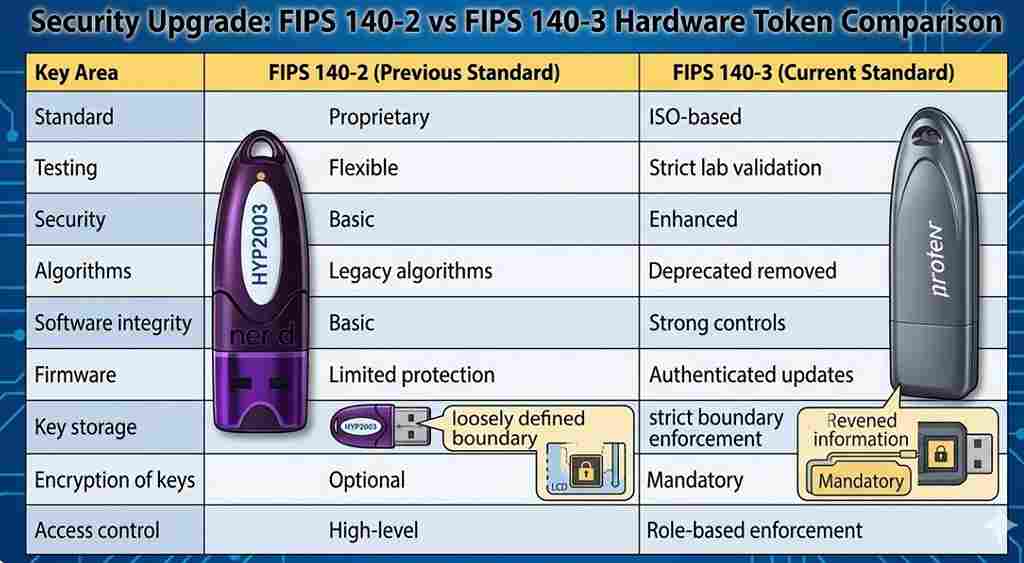
| Area | FIPS 140-2 | FIPS 140-3 |
|---|---|---|
| Standard | Proprietary | ISO-based |
| Testing | Flexible | Strict lab validation |
| Security | Basic | Enhanced |
| Algorithms | Legacy allowed | Deprecated removed |
| Software integrity | Basic | Strong controls |
| Firmware | Limited protection | Authenticated updates |
| Key storage | Loosely defined | Strict boundary enforcement |
| Encryption of keys | Optional | Mandatory |
| Access control | High-level | Role-based enforcement |
📊 Compliance Matrix (Simplified)
| Stakeholder | Requirement | Deadline |
|---|---|---|
| OEM/Distributor | FIPS 140-3 audit | May 2026 |
| Certifying Authority | Integration & audit | July 2026 |
| Government Org | Optional use (with approval) | Till Sept 2029 |
| Other Users | Migration recommended | ASAP |
🚨 What Should You Do Now?
✔️ If You Are a DSC User:
- Plan upgrade to FIPS 140-3 token
- Avoid last-minute migration
- Ensure compatibility with systems
✔️ If You Are a Business:
- Audit existing cryptographic usage
- Prepare migration roadmap
- Replace outdated tokens
✔️ If You Are a CA / Vendor:
- Implement compliance immediately
- Publish policies
- Educate customers
🛒 Where to Buy FIPS 140-3 DSC Token?
If you’re looking for a trusted and fast DSC provider, you can apply through:
👉 Digital Signature Spot
✔️ What You Get:
- Class 3 DSC (Individual & Organization)
- Latest FIPS 140-3 USB Tokens
- Fast approval process
- Complete end-to-end support
📲 WhatsApp Support: 7579984381
❓ Frequently Asked Questions (FAQ)
Q1. Can I continue using my old DSC?
Yes, until expiry.
Q2. Can I renew DSC on old token?
No, renewal requires FIPS 140-3.
Q3. Is migration mandatory?
Yes, before September 2029.
Q4. Are government organizations exempt?
Only temporarily, with approval.
🎯 Final Conclusion
The transition from FIPS 140-2 to FIPS 140-3 is not just a compliance requirement — it is a strategic upgrade in security infrastructure.
Organizations that act early will benefit from:
- Stronger data protection
- Regulatory compliance
- Future-ready systems
Delaying this transition can lead to:
- Service disruption
- Compliance risks
- Operational challenges
📢 Take Action Today
🚀 Upgrade your DSC to FIPS 140-3 now
👉 Apply with Digital Signature Spot
📲 WhatsApp: 7579984381


About author









Add comment