

Class 2 vs Class 3 DSC: Major Differences, Uses & Latest Rules (2026)
Introduction
Class 2 vs Class 3 DSC: Digital Signature Certificates (DSC) play an important role in secure online transactions and document authentication in India. Many government portals such as Income Tax, GST, MCA, and eTender platforms require users to digitally sign documents for verification.
Earlier, users had the option to choose between Class 2 DSC and Class 3 DSC, which often caused confusion about which certificate should be used.
However, the digital signature framework in India has evolved, and today Class 3 DSC has replaced Class 2 DSC for most applications.
In this guide, we will explain:
- What Class 2 DSC was
- What Class 3 DSC is
- The key differences between Class 2 vs Class 3 DSC
- Where Class 3 DSC is used
- Why Class 3 DSC is now mandatory
This will help you clearly understand which digital signature certificate is required today.
Read Also – https://digitalsignaturespot.com/how-to-buy-class-3-digital-signature-certificate-online/
What Was Class 2 DSC?
Class 2 Digital Signature Certificate was previously used for moderate-level identity verification. It confirmed the identity of a user against a trusted database but required less strict verification compared to higher security certificates.
Common Uses of Class 2 DSC (Earlier)
Class 2 DSC was commonly used for:
- Income Tax e-filing
- MCA (Ministry of Corporate Affairs) filings
- GST registration and filings
- Director KYC verification
- Company compliance submissions
Important Update
To improve digital security standards, the Controller of Certifying Authorities (CCA) discontinued Class 2 DSC.
Because of this change, Class 3 DSC is now used for almost all digital signature applications.
What is Class 3 DSC?
A Class 3 Digital Signature Certificate is the highest level of DSC issued in India. It provides strong authentication and secure digital signing.
This certificate requires strict identity verification, usually through:
- Aadhaar OTP authentication
- Video verification
- PAN verification
Because of its higher security level, Class 3 DSC is widely used for government portals and business transactions.
Class 2 vs Class 3 DSC – Comparison Table
Below is a simple comparison to understand the difference between Class 2 and Class 3 Digital Signature Certificates.
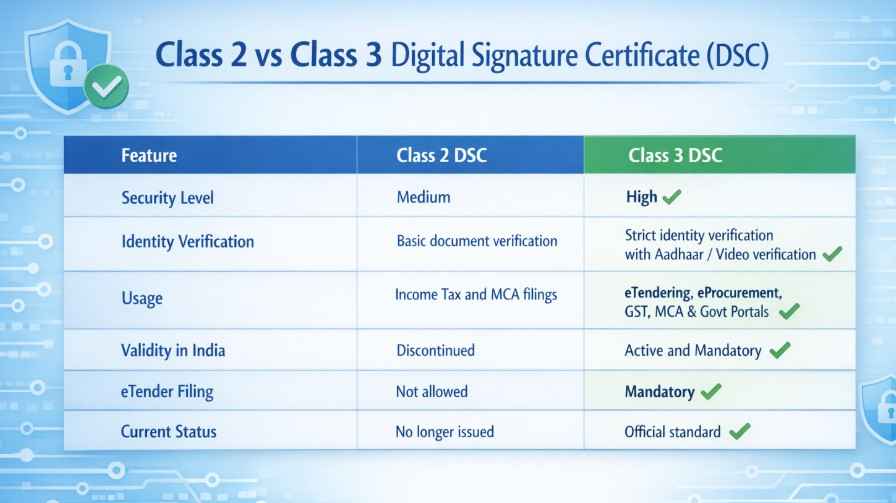
| Feature | Class 2 DSC | Class 3 DSC |
|---|---|---|
| Security Level | Moderate | High |
| Identity Verification | Basic database verification | Aadhaar OTP / Video verification |
| Usage | Income tax, MCA filings (earlier) | Tender, GST, MCA, Income Tax |
| Current Status | Discontinued | Active and widely used |
| eTender Usage | Not allowed | Mandatory |
Key Takeaway
Class 3 DSC has replaced Class 2 DSC and is now the standard digital signature certificate in India.
Uses of Class 3 Digital Signature Certificate
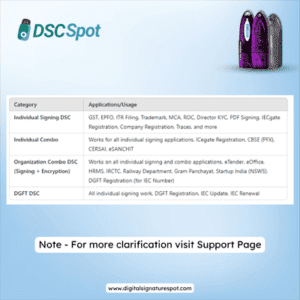
Class 3 DSC is used for multiple government and business applications.
Government Compliance
- Income Tax e-filing
- GST filings
- MCA company filings
Tender Participation
- Government e-tender submissions
- e-Procurement portals
- Contractor registrations
Business and Trade
- Trademark and patent filing
- DGFT portal submissions
- ICEGATE import-export filings
Because of these uses, Class 3 DSC is now the most widely used digital signature certificate in India.
Why Class 3 DSC is Mandatory Today
The government strengthened digital authentication requirements to reduce fraud and improve security.
Reasons Class 3 DSC is Required
Higher Security
Class 3 DSC offers stronger authentication compared to earlier certificates.
Prevention of Identity Misuse
Strict verification ensures that the certificate holder’s identity is confirmed.
Legal Compliance
Government portals require digital signatures that meet security standards under the Information Technology Act, 2000.
Because of these reasons, Class 3 DSC is now mandatory for most official digital signing processes.
How to Upgrade from Class 2 DSC to Class 3 DSC
If you previously had a Class 2 DSC, it cannot be renewed anymore. Instead, you must apply for a new Class 3 Digital Signature Certificate.
Upgrade Process
- Apply online for a Class 3 DSC
- Fill the digital signature application form
- Complete Aadhaar OTP or video verification
- Documents are approved by the Certifying Authority
- Login to the Digital Signature eKYC account
- Complete the online payment
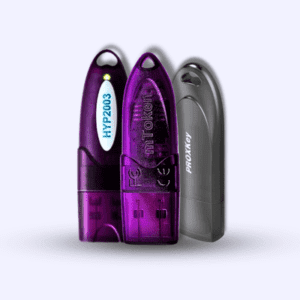
- Download and install the DSC in your USB token
After installation, you can start using the DSC for government portals and digital signing.
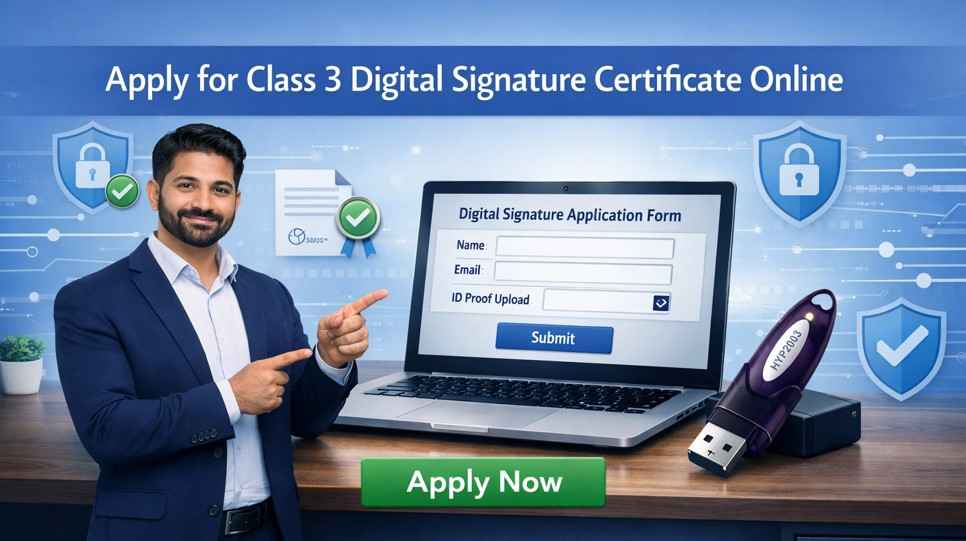
Apply for Class 3 Digital Signature Certificate
If you want to buy or renew Class 3 DSC online, our team can help you with quick issuance and complete installation guidance.
We provide:
✔ New DSC issuance
✔ DSC renewal
✔ USB token setup support
✔ Token driver installation
✔ Digital signature troubleshooting
Apply online:
📞 Call / WhatsApp: 7579984381
https://digitalsignaturespot.com/product/digital-signature-certificate-renewal-online/
Our team will guide you step-by-step and help you get your digital signature certificate issued quickly.
Frequently Asked Questions (FAQ)
What is the difference between Class 2 and Class 3 DSC?
Class 2 DSC had moderate security and basic identity verification, while Class 3 DSC provides stronger authentication with strict identity verification.
Is Class 2 DSC still valid?
No. Class 2 DSC has been discontinued in India and is no longer issued.
Can Class 3 DSC be used for Income Tax filing?
Yes. Class 3 DSC can be used for Income Tax filings, GST filings, MCA filings, and other government portals.
Is Class 3 DSC required for eTender?
Yes. Government e-tender portals require Class 3 Digital Signature Certificate.
How long does it take to issue a Class 3 DSC?
Most DSCs are issued within 15–30 minutes after verification and payment.
About the Author
Smarth is a Digital Signature expert associated with Digital Signature Spot, helping businesses and professionals obtain Digital Signature Certificates quickly and securely.
With extensive experience in DSC issuance, token installation, and portal troubleshooting, he regularly publishes guides to help users understand digital signatures and resolve DSC-related technical issues.

About author





Add comment